Hanji Patch Combines 3D-Printed Microneedles and Uric-Acid Sensing
A Jeonbuk National University team placed 3D-printed drug-delivery microneedles and a wireless sweat uric-acid sensor on breathable hanji. The two functions were evaluated separately; integrated operation on the body has not yet been demonstrated.
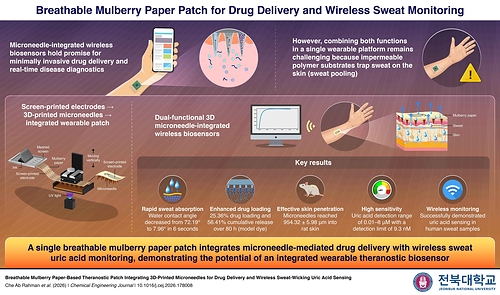
3D Printing Industry reports that a Jeonbuk National University team described a hanji-based wearable patch in Chemical Engineering Journal. Light-cured microneedles were formed on the paper without adhesive; the study reported 25.36% drug loading and penetration of about 954 µm into excised rat skin.
The uric-acid sensor covered 0.01–8 µM with a 9.3 nM detection limit and recovered 98.1–101.3% of known concentrations. Drug delivery and sensing were tested separately, leaving clinical drugs, skin safety and real-time integrated on-body trials for future work.
Key facts
- Microneedle drug loading reached 25.36%
- The uric-acid sensor detection limit was 9.3 nM
- No integrated human trial of delivery and sensing has been completed
Context
The work points to a breathable paper platform combining treatment and monitoring, but remains a laboratory evaluation of separate functions.