ScaffoldForge Generates Bone-Scaffold Designs in 12 Seconds In Silico
The conditional diffusion model maps eight trabecular descriptors to scaffold geometry; all reported results are computational, with no printing or biological testing.
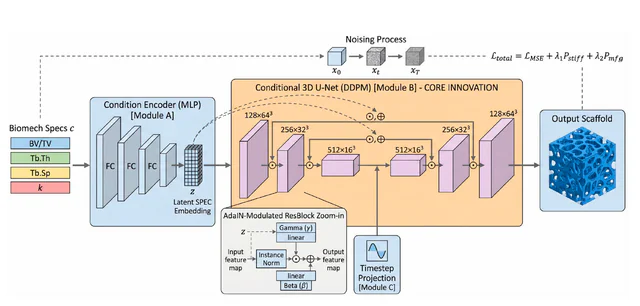
Researchers have reported ScaffoldForge in PLOS One, a conditional diffusion model that generates 3D bone-scaffold geometry from eight trabecular descriptors. It produced a 64³-voxel design in about 12 seconds, roughly 700 times faster than the compared topology-optimization workflow at about 8,400 seconds. Simulated compressive strength reached 56.6 MPa, 8.2% above the topology-optimization baseline.
Only 50 of the 250 training examples were real datasets, and every reported result is computational. No scaffold was printed, mechanically tested, evaluated with cells or animals, or used clinically. Errors increased on unseen anatomy, while strength and permeability were estimated by neural networks. ScaffoldForge is currently a design-research method, not evidence of medical performance.
Key facts
- A 64³-voxel design was generated in about 12 seconds
- The reported speedup versus topology optimization was about 700×
- Only 50 of 250 training examples were real; no physical or biological validation was performed
Context
The method could accelerate patient-specific design exploration, but manufacturability, mechanics and biology still require physical validation.