Northwestern team develops DIAL printing for yield-stress inks
A Northwestern University team reports DIAL, which spreads paste-like ink into 50 µm sheets and cures each layer with patterned light. A porous lattice took 30 minutes versus 124 minutes with the compared extrusion process.
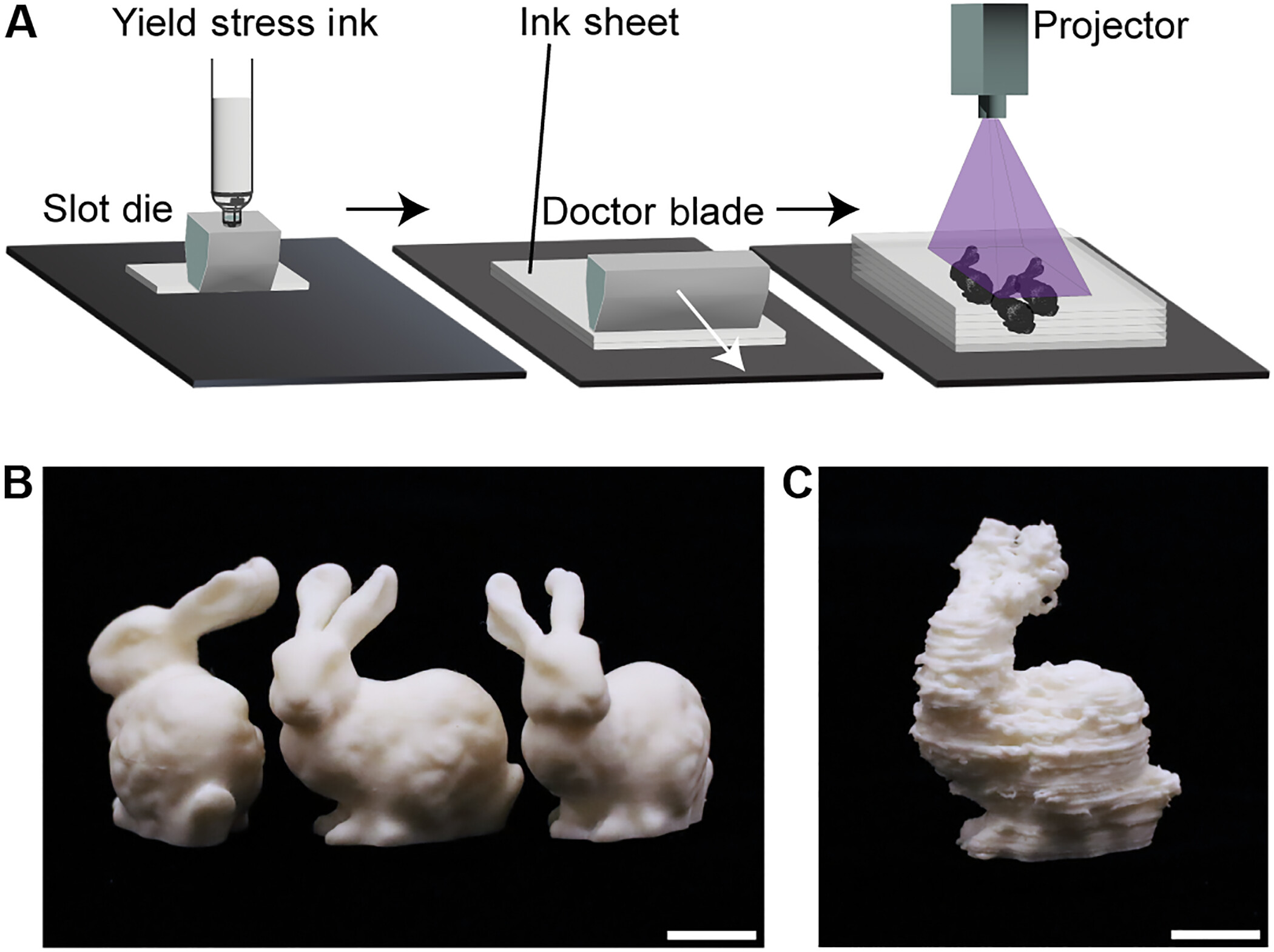
Direct Ink Additive Lithography, or DIAL, feeds a yield-stress ink through a slot die, spreads it into a 50 µm sheet with a doctor blade, and cures selected regions using projected light. Uncured ink supports the part, while pixels and layer thickness—not a fine nozzle—set the feature scale.
The Science Advances study published November 4 reports 150 µm lattice walls and a 30-minute build for a porous lattice, compared with 124 minutes for the extrusion process used in the test. The team also demonstrated electrolyte structures and hydrogel culture vessels. It remains a laboratory result; industrial throughput, cost and broad material compatibility have not yet been established.
Key facts
- Ink is spread into 50 µm sheets and selectively photocured
- A porous lattice took 30 minutes with DIAL versus 124 minutes in the extrusion comparison
- The study demonstrated 150 µm lattice walls
Context
Layer-wide curing of paste and particle-filled inks could combine the material range of extrusion with faster production of fine structures.