UNIST Uses Guided Ultrasound to Time the Next Layer in Concrete 3D Printing
A UNIST research team has developed a method that continuously estimates the green strength of fresh concrete using an acrylic waveguide and two piezoelectric sensors mounted on one side of a printed element.
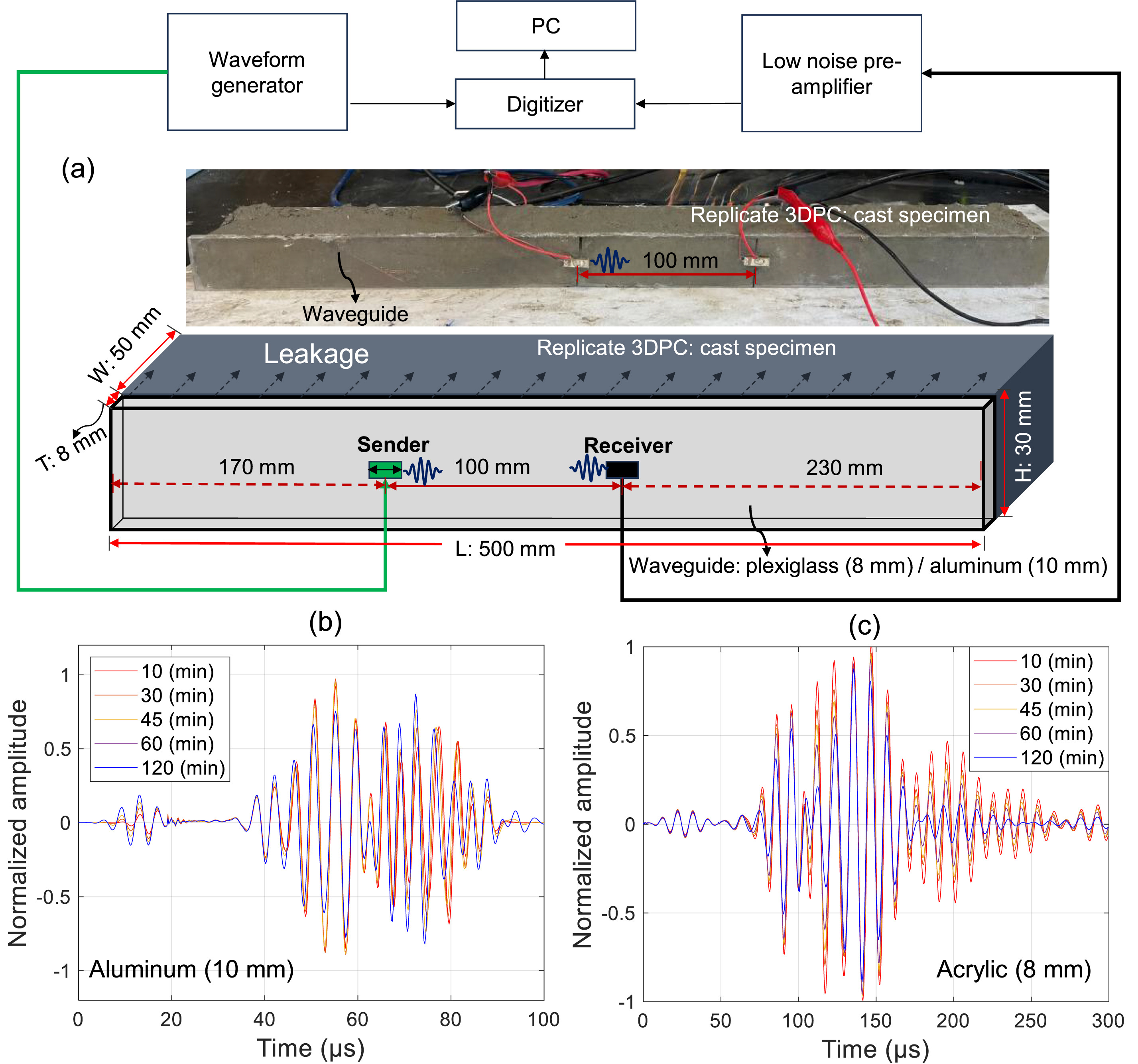
Researchers at South Korea’s Ulsan National Institute of Science and Technology developed an ultrasonic guided-wave method for monitoring the green strength of 3D-printed concrete from one side. A transmitter and receiver made from piezoelectric sensors are bonded to an acrylic plate mounted against the printed element.
As the concrete hardens and mechanical coupling increases, more ultrasonic energy leaks from the waveguide into the concrete, reducing the received amplitude. Tests from 10 to 120 minutes after fabrication covered a reference mix and two mixes with different cellulose-microfiber lengths. Guided S0-mode indicators produced coefficients of determination from 0.927 to 0.975 against compressive green-strength measurements.
The same trend appeared in a small three-layer printed specimen, but the method has not been demonstrated at building scale. Stability across temperature, humidity, structure size and mixture design—and closed-loop control of print speed or interlayer waiting time—remain subjects for further work.
Key facts
- Acrylic waveguide with two piezoelectric sensors mounted on one side
- Green-strength development measured from 10 to 120 minutes
- Ultrasonic indicators achieved R² values of 0.927–0.975 against compressive strength
- Demonstrated only on a small three-layer specimen
Context
The technique could replace fixed layer delays with material-state measurements, potentially reducing collapse risk and unnecessary waiting in construction 3D printing.