Khalifa University 3D Prints Iron-Oxide Nanozyme Contact Lenses
Researchers formed iron-oxide nanoparticles inside 3D-printed HEMA/PEGDA lenses and measured catalytic activity under hydrogen peroxide plus cytokine suppression in cell tests. No on-eye or clinical testing was reported.
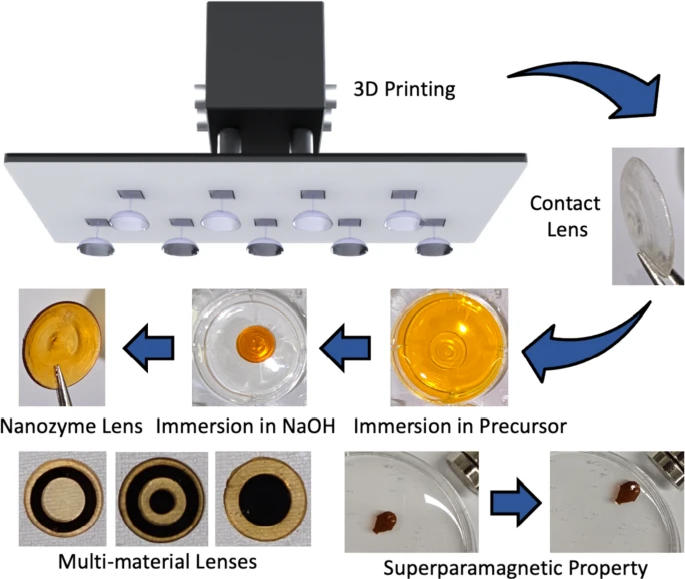
A Khalifa University of Science and Technology team 3D printed contact-lens geometries from 2-hydroxyethyl methacrylate (HEMA) and polyethylene glycol diacrylate (PEGDA), then formed iron-oxide nanoparticles inside the hydrogels by in-situ precipitation. The study appeared in Advanced Composites and Hybrid Materials on November 4, 2026. Under hydrogen peroxide, the lenses showed catalytic activity; the 75:25 HEMA:PEGDA formulation outperformed the particle-richer 100:0 formulation in catalytic activity and methylene-blue removal.
All tested formulations maintained good viability in human dermal fibroblast cultures, while the 75:25 lens also reduced measured cytokine signals. The iron-oxide-loaded hydrogels responded to an external magnetic field because of the particles' superparamagnetic behavior. These are laboratory and cell-culture results: the team did not report on-eye, animal or human testing, nor long-term particle leaching, oxygen permeability, comfort or clinical benefit.
Key facts
- The lenses were 3D printed from HEMA and PEGDA, with iron-oxide nanoparticles added by in-situ precipitation
- A 75:25 HEMA:PEGDA ratio performed best for catalytic activity and methylene-blue removal
- Cell testing used human dermal fibroblasts; no on-eye testing was reported
Context
The work shows how catalytic functionality could be built into a 3D-printed hydrogel lens, but ocular use still requires validation of optics, oxygen transport, particle stability and in-vivo safety.