3D-Printed Brain-Cooling Implant Suppresses Seizure-Like Activity in Rats
A European research team used direct ink writing to build a 10 × 10 × 3 mm silicone device combining focal cortical cooling with electrical recording.
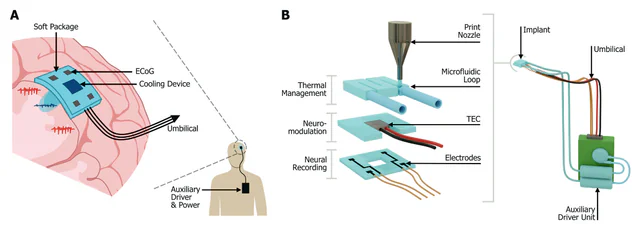
The team printed DOWSIL SE1700 silicone on a RegenHU 3D Discovery system, integrating graphite-composite electrodes, a thermoelectric cooler, and a water channel in three stacked modules. In 37°C agar gel, it reached 23°C in about five seconds, held the target within ±0.25°C, cooled 1–3 mm deep, and drew 2.6 W at steady state.
In nine anesthetized rats with drug-induced seizure-like activity, 60-second cooling events between 15°C and 25°C reduced average signal energy at every tested temperature. Delta-band energy fell 48% ± 35% at 18°C, but activity returned after cooling stopped. This is preclinical research, not evidence of clinical efficacy; miniaturization, long-term packaging, power, and safety validation remain.
Key facts
- Device size: 10 × 10 × 3 mm
- Process: DIW, three-layer silicone structure
- About five seconds to 23°C in agar; cooling depth 1–3 mm
- Seizure-like activity evaluated in nine rats
Context
The work integrates cooling, heat removal, and brain-signal recording in a soft compact package, but long-term preclinical and clinical validation is still required.