Michael Rechtin Prototypes an EDF Afterburner With Consumer 3D Printers
Aerospace engineer Michael Rechtin used Onshape and Bambu Lab 3D printers to prototype a propane afterburner for an electric ducted fan (EDF) and compare it on a thrust stand. Nanjixiong reports only a few percent of added thrust, before accounting for the assembly’s extra mass and drag.
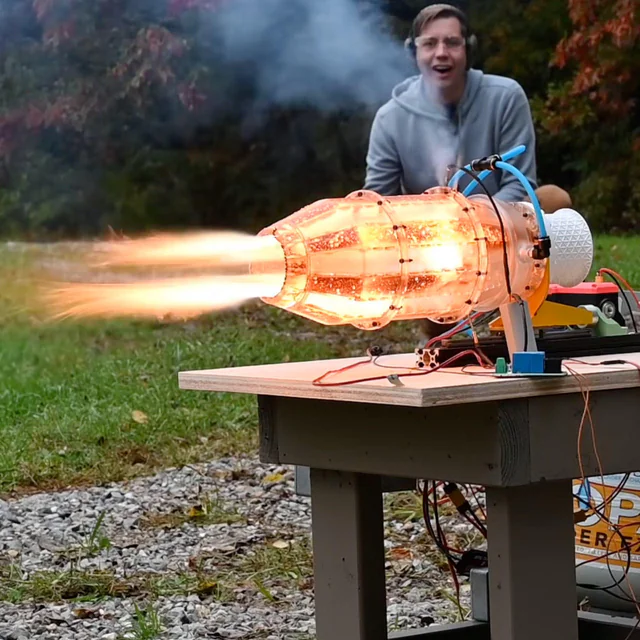
Chinese additive-manufacturing outlet Nanjixiong reported on November 1, 2026, on a personal EDF-afterburner experiment by aerospace engineer Michael Rechtin. Rechtin designed the assembly in Onshape and printed structural parts on Bambu Lab machines. A propane supply and ignition system was installed downstream of the EDF so the flame could be sustained while thrust was measured.
According to the report, Rechtin compared the EDF alone with the same fan operating with the afterburner on a thrust stand. Printed housings, fuel rings and flame-holding elements reportedly survived the heat and airflow long enough to collect measurements. The reported gain was only a few percent at best, and the result did not subtract the afterburner’s added mass or drag.
The evidence is a creator-led build and test relayed by Nanjixiong, not an independently validated performance study. A low-pressure EDF offers far less room for heat-driven thrust augmentation than a turbine-compressed jet engine. Even so, the ability to revise nozzle geometry, injector placement and cooling paths on short print cycles shows how desktop additive manufacturing is moving from visual prototypes toward instrumented functional experiments. Propane, high temperatures and printed polymers also create serious fire, melting and pressurized-fuel hazards; this is not a general replication guide.
Key facts
- The assembly was designed in Onshape and its structural parts were printed on Bambu Lab machines.
- A propane delivery and ignition system was installed downstream of the EDF for comparative thrust testing.
- Nanjixiong reports only a few percent of added thrust; net performance including extra mass and drag was not established.
Context
The project shows desktop 3D printing being used for measurable functional prototypes involving combustion and airflow, with rapid geometry iteration. It does not establish a practical propulsion benefit.