3D-Printed Shoe Fails After 18 Months, Raising Lattice Design Questions
AM Insight Asia examines a 3D-printed shoe that failed after about 18 months, focusing on stress concentration at its V-shaped opening and the absence of crack-arrest features.
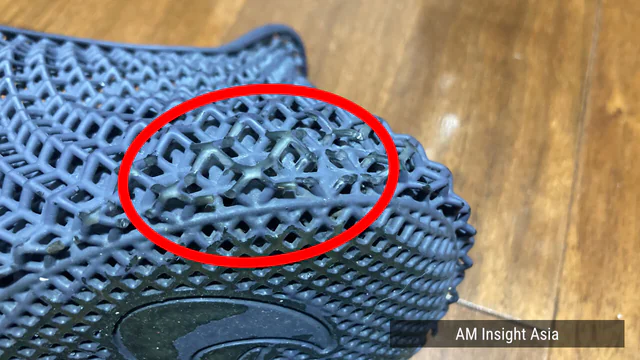
AM Insight Asia editor Chikai Eto has documented the failure of a one-piece lattice shoe that cost about ¥26,000 and tore at the upper opening after roughly 18 months of use. He says the pair was worn about every other day except during winter. The sole and the toe-side instep, which flexes during walking, showed no major damage.
The tear travelled diagonally toward the toe from the apex of the V-shaped opening and followed valleys in the lattice. Eto argues that insertion loads concentrated at the V apex and that the continuous lattice lacked a thicker section that could arrest crack growth. He suggests reinforcing the rim or combining lattice regions of different thicknesses as possible fail-safe design measures.
Comments from specialists also raised fatigue at lattice nodes, build-orientation anisotropy and UV degradation as possible material or manufacturing factors. This is an observation of one pair with the product and manufacturer intentionally unidentified, not a fracture analysis or controlled comparison. The design-based explanation is the author’s hypothesis and should not be generalized to the durability of 3D-printed footwear as a whole.
Key facts
- Purchase price was about ¥26,000
- Used for roughly 18 months
- Worn about every other day except in winter
- Tear propagated from the V-shaped opening along lattice valleys
Context
The case highlights the need to consider crack propagation after local damage and an acceptable service life when designing consumer AM products.