TANIOBIS prints C-103 and FS-85 niobium nozzles on four-laser LPBF system
TANIOBIS transferred C-103 and FS-85 parameters to a four-laser EOS AM500Q and printed rocket nozzles without visible cracks. The work does not constitute flight qualification or production approval.
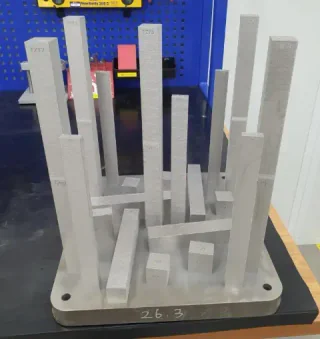
TANIOBIS transferred PBF-LB parameters for niobium alloys C-103 and FS-85 from a single-laser EOS AM400 to a four-laser AM500Q. Parts showed porosity below 0.1% and optical density above 99.9%; demonstrator nozzles measuring 53 mm in diameter and 100 mm high had no visible cracks.
Across 52 test cubes distributed over the build plate, porosity remained below 0.3% apart from a few outliers attributed to spatter. Reported room-temperature tensile strength was about 565 MPa for C-103 and 750 MPa for FS-85. FS-85 retained about 220 MPa tensile strength at 1,500°C.
3D Printing Industry reported the research, while the material and process data come from TANIOBIS testing. The work demonstrates multi-laser printability but does not establish aerospace qualification, long-term durability or production quality assurance.
Key facts
- Printing used four lasers on an EOS AM500Q
- Demonstrator nozzles measured 53 mm by 100 mm
- Reported part porosity was below 0.1%
Context
The study provides a process basis for moving high-temperature niobium alloys to multi-laser LPBF.