HUST Develops Multi-Material 3D-Printed Armor Inspired by Seahorse Tails
HUST used PolyJet printing to reproduce the soft-hard interlocking mechanism of a seahorse tail in a flexible exoskeleton structure.
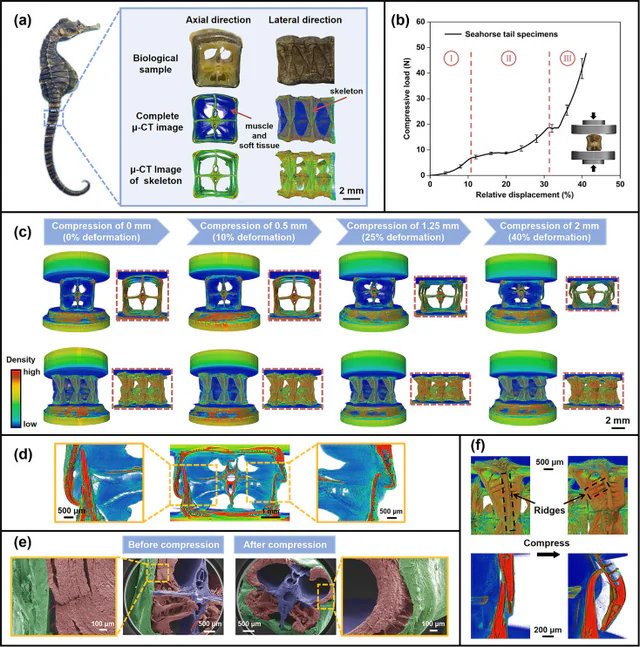
A HUST team translated the way soft tissue and hard skeletal elements in a seahorse tail interlock under compression into an integrated soft-hard structure. The PolyJet prototype was tested under compression, cyclic loading, drop impact, bending, and twisting, with finite-element analysis.
The paper reports a maximum load of 351 N—about 3,000 times the structure's own weight—while remaining intact at 30% compression. Deep-sea equipment and wearable protection are proposed future applications; the work remains experimental.
Key facts
- Process: multi-material PolyJet printing
- Maximum load: 351 N, about 3,000× structure weight
- Structure remained intact at 30% compression
- Paper: Additive Manufacturing Frontiers 200344
Context
The study demonstrates an integrated soft-hard protective structure whose stiffness changes with deformation.