KIT Converts 2PP Nanoprints into 6 GPa Silica Glass
Karlsruhe Institute of Technology mapped how two-photon-polymerized POSS structures convert into silica glass during thermolysis, reporting tensile strength up to 6 GPa in fully converted specimens.
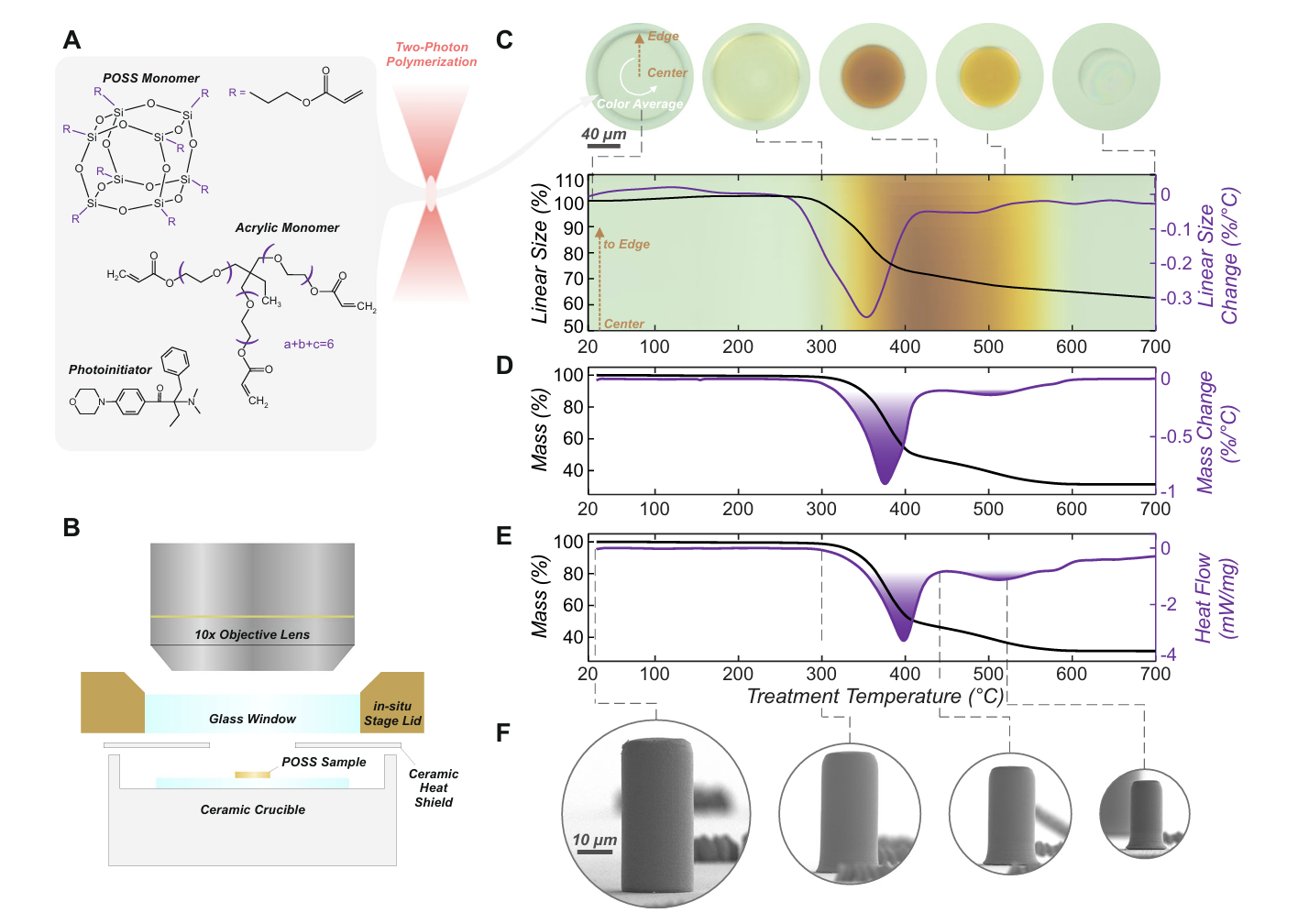
Researchers at Karlsruhe Institute of Technology studied how polyhedral oligomeric silsesquioxane (POSS) resin structures made by two-photon polymerization convert into silica glass during heat treatment. The paper was published in Communications Materials on October 30, 2026.
Heating in air removes the organic fraction and reorganizes the silicon-oxygen clusters into a continuous inorganic network. The printed structures undergo about 40% isotropic linear shrinkage, and pure silica glass forms above 650°C. Thermal analysis, micromechanical testing and optical photothermal infrared spectroscopy identified three stages from rubber-like behavior through glass-ceramic response to dense glass.
Fully converted microscale specimens reached tensile strength up to 6 GPa, which the authors describe as a record for materials made by 2PP. The result applies to tested microstructures and should not be read as the strength of conventional large glass components.
Key facts
- POSS resin was patterned by two-photon polymerization
- Thermal conversion caused about 40% isotropic linear shrinkage
- Pure silica glass formed above 650°C
- Fully converted microscale specimens reached up to 6 GPa
Context
Mapping each conversion stage provides a basis for controlling shrinkage and strength in high-resolution 2PP glass manufacturing.