Providence Begins Commercial Use of 3D-Printed Cervical Implant
Providence Medical Technology has completed the first commercial procedures using its FDA-cleared porous-titanium CORUS PCSS 3D-T at two U.S. hospitals.
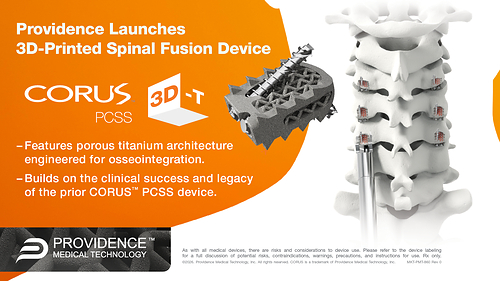
Providence Medical Technology says the first commercial procedures using its CORUS PCSS 3D-T posterior cervical stabilization system have been completed at Adventist Health White Memorial in Los Angeles and Bon Secours Memorial Regional Medical Center in Virginia. The implant uses a 3D-printed porous titanium lattice and is placed through a posterior approach.
The FDA 510(k) database lists a substantial-equivalence decision for CORUS PCSS 3D (K253676) on May 14, 2026. It is indicated for up to three consecutive levels from C3 to C7, is manufactured from medical-grade Ti-6Al-4V, and is supplied sterile for single use with autograft or allograft.
Providence says the lattice provides 1.5 times the surface area and eight times the roughness of its original machined implant. Those are company design comparisons; long-term fusion and revision outcomes for the 3D-T version have not yet been reported.
Key facts
- The first commercial procedures were completed in California and Virginia
- The FDA 510(k) is K253676 with a May 14, 2026 decision date
- The indication covers up to three consecutive levels from C3 to C7
- The implant uses a porous Ti-6Al-4V lattice
Context
A porous 3D-printed cervical implant has moved from regulatory clearance into commercial use, while device-specific long-term outcomes remain to be established.